Best Portable Ring Toss Game for Kids: A Park Setup Guide
Choose a portable ring toss game for kids by age labeling, base and ring storage, setup footprint, and a short parent-led throwing lane.
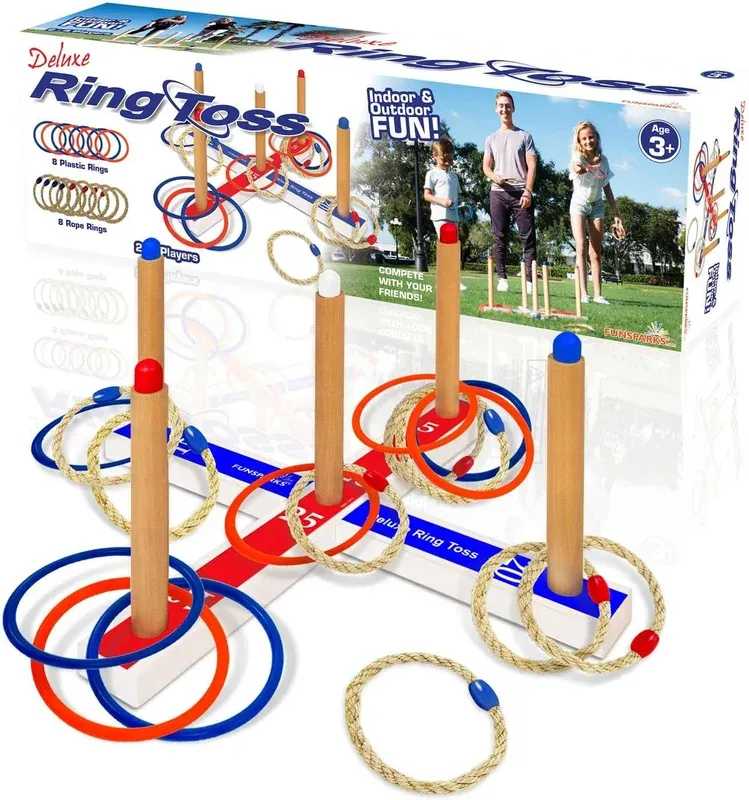
The best portable ring toss game for a park is the one whose pieces fit the child’s age, stay together in your bag, and can be placed without blocking a shared route. A parent can start with a close handoff and a large target before asking a child to throw. Compare the base, rings, storage, and setup footprint rather than choosing by a colorful box.
These recommendations are researched, not hands-on tested. Product labels and availability can change, so read the current package and product page before buying.
A verified portable set
Funsparks Ring Toss Deluxe includes 16 rings—eight rope and eight plastic—along with a wooden base, five score pegs, and a carry bag. Funsparks’ manufacturer page lists the set for ages 4+, describes indoor/outdoor play, and explains that the pieces pack into the bag. Choose it when four players need enough rings for turns and an adult can place the base on a clear, level area. The 4+ label applies to this exact set; it does not make every ring toss game suitable for younger children.
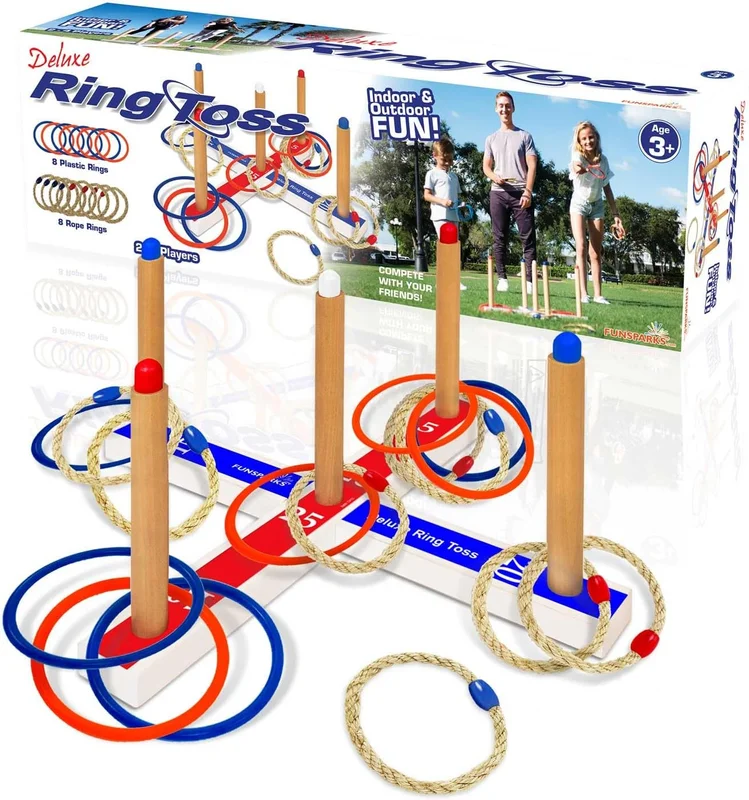
Funsparks Ring Toss Deluxe
What to compare
Age label and piece count
Read the age guidance for the exact set and count its pieces before leaving home. The CPSC Toy Safety FAQ advises adults to consider age recommendations and supervise children’s products. Keep rings with the adult when the youngest player is still mouthing objects, and inspect them for damage before use.
Base and target design
Check how the base sits and how much floor or grass it needs. A set that requires a stake or uneven setup may not suit your park spot; follow the manufacturer’s instructions instead of improvising a placement. Never put a target on a path, at the foot of stairs, or near a swing exit.
Ring size and carrying
Compare the rings with the child’s hands and the carry bag. If a page does not list a dimension, treat it as unknown. A portable game is only portable for your family if the rings, base, and any poles fit together and can be counted before you leave.
Adjustable distance
Choose a game whose throwing line can move. A toddler may hand a ring to the adult or place it over a nearby target. An older child can take a few steps back after the first successful turn. The target games for kids guide gives variations without relying on a formal board.
Build a parent-led round
Set up in a clear, visible area away from paths, roads, playground exits, sports play, and other families. Start with one ring and a target within arm’s reach. Say “over” or “around,” let the child place or gently toss it, and have the adult retrieve it. Add distance only when the child can wait for the lane to clear.
For a mixed-age party, make the target closer for younger children and farther for older children. Everyone gets three turns before the adult moves the line. A cooperative goal such as “fill the target together” keeps children playing after a miss; see the cooperative outdoor games guide for more formats.
When a different game is better
Skip the set when the park has no clear placement area, when the youngest child cannot keep rings out of their mouth, or when the pieces are likely to scatter into plants. A parent-held handoff game or a no-equipment park party game may fit the day better.
Pack-out routine
Count rings before setting up. Keep the storage bag beside the adult, pause play when another visitor approaches, and count again before packing. Leave the ground and nearby plants as you found them, consistent with the National Park Service’s Leave No Trace principles.
Sources
- Amazon, Funsparks Ring Toss Deluxe (B079F4D531), retrieved 2026-09-12.
- Funsparks, Ring Toss Deluxe, retrieved 2026-09-12.
- U.S. Consumer Product Safety Commission, Toy Safety FAQ, retrieved 2026-09-06.
- National Park Service, Leave No Trace Seven Principles, retrieved 2026-09-06.
Explore more park games.