Copycat Games for Kids: Easy Imitation Play at the Park
Try copycat games for kids with movement, sounds, and child-led turns. These park ideas need no equipment and work in small spaces.
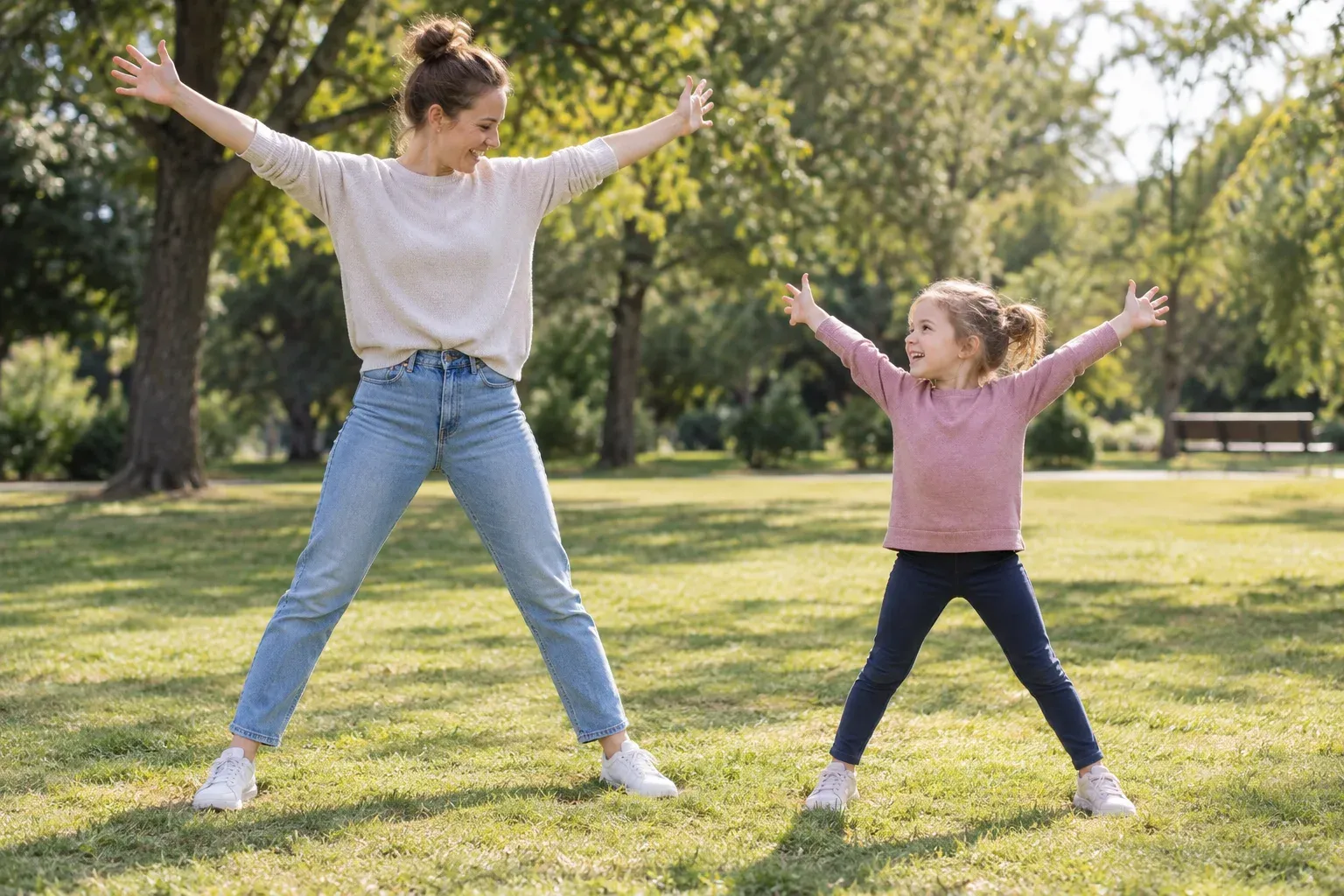
Copycat games give children a clear way to join play: watch one action, then try it. At the park, use movements that stay in place or travel only a few steps. Begin as the leader, then hand over the role. The games below work with a toddler, a preschooler, siblings, or a small party group.
Make copying easy
Stand where everyone can see your whole body. Use one action at a time and hold it long enough for a child to notice. Keep the play zone away from paths, swings, and slide exits. If the park is crowded, use hand motions, faces, and sounds while seated.
The National Park Service’s Leave No Trace guidance asks visitors to be considerate of others. Keep sounds low, do not block shared routes, and avoid using plants or natural objects as props. The adult can point to a park feature without asking children to touch it.
Four copycat games
Copy my shape
Make a simple shape: arms up, hands on hips, one knee bent, or a wide star. Hold it for three seconds, then relax. The child copies. After two rounds, ask the child to choose the next shape. A seated version works for toddlers who are tired or waiting near a picnic area.
Copy my path
Walk three steps to a landmark and stop. The child follows the same route. Add a turn, a pause, or a slow reach. Keep the path short enough that you can see the child at every moment. Never ask a child to walk backward without an adult checking the space.
Copy my sound
Make a quiet sound such as a hum, clap, tap, or animal noise. The child repeats it, then chooses a sound. Give other park users room by keeping the volume gentle. If the child does not want to make a sound, let them copy a hand movement instead.
Copycat storyteller
Build a pretend story one action at a time. You open an imaginary gate, the child copies, then you look around and the child copies. After four actions, ask the child what happens next. This turns imitation into shared storytelling without needing costumes or toys.
How do you include different ages?
Give toddlers one-step actions and a close adult position. Let preschoolers combine two actions. Let ages 5–7 lead a short sequence, but ask them to keep the pattern visible and easy to follow. A child who does not want to lead can be the “mirror checker” and point out when everyone matches.
Avoid correcting body positions. “Try it your way” keeps imitation playful and gives the child control. If the group gets silly or fast, return to one slow shape. Link to follow-the-leader outdoor play when you want a route with rotating leaders.
End with a child-created round
Give each child one final turn, then say “copycat is finished.” Let the last leader choose a quiet pose everyone can hold for three counts. Gather any items you brought and leave the area clear. An intentional ending helps the group move to climbing, snack, or the trip home.
For a lower-energy option after imitation gets loud, try quiet outdoor games for toddlers and keep the adult close.
Sources
- National Park Service, Leave No Trace Seven Principles, retrieved 2026-09-06.
- Playworks, Simon Says game library, retrieved 2026-09-06. Used for adult-led imitation prompts; the copycat variations above are original.
Explore more park games.