Circle Games for Preschoolers Outside: Keep the Ring Moving
Try circle games for preschoolers outside with name-and-motion, pass-the-clap, color calls, and cooperative statues.
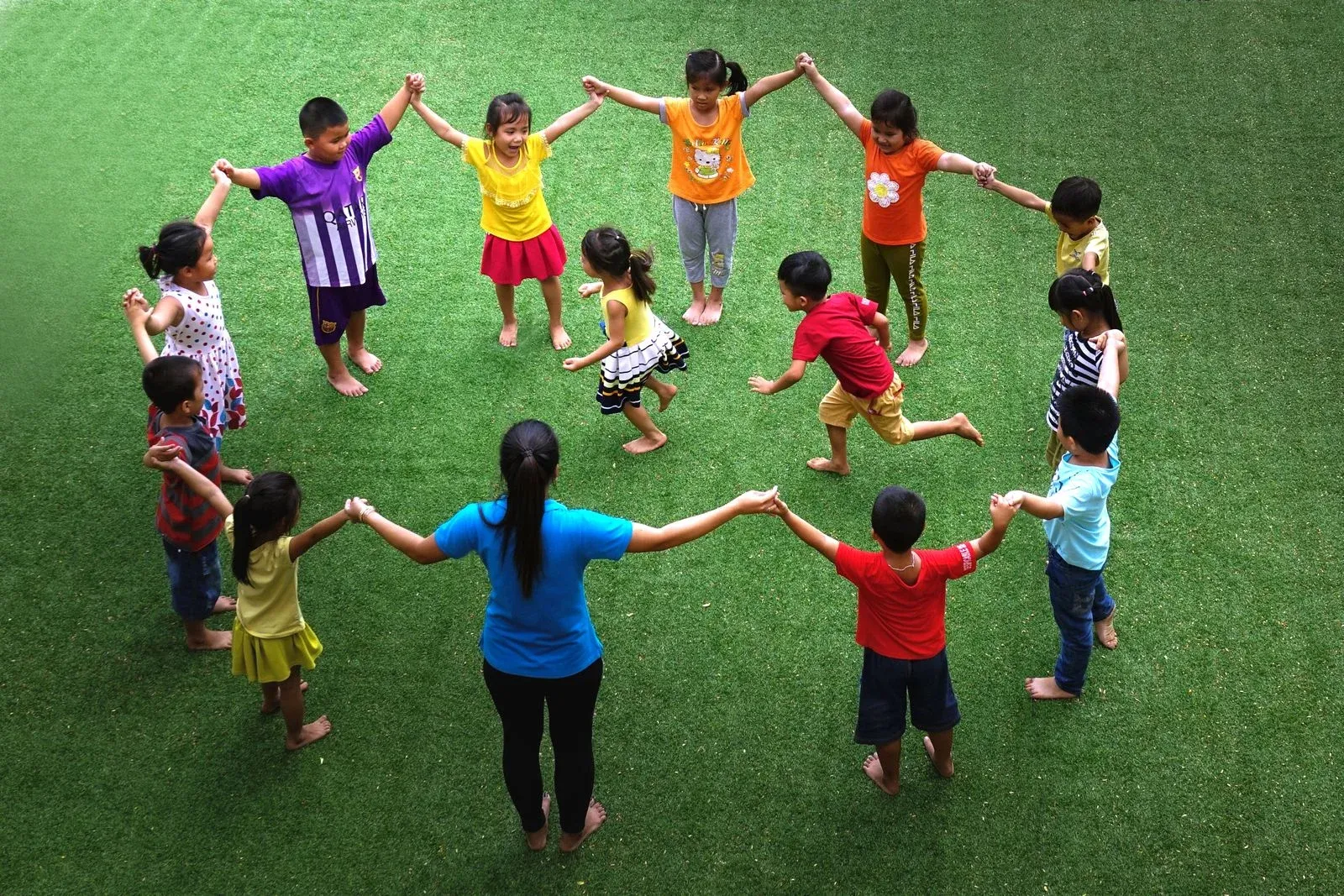
An outdoor circle game needs a small, visible ring and one adult who watches the surrounding space. Use seated or standing formats with no pushing, chasing, or elimination. Keep the circle away from paths and playground exits, and let a child leave the ring without making it a dramatic event. A play parachute turns any circle into a game. See the best play parachute for kids.
Set up the circle
Choose level ground away from roads, paths, swing arcs, and slide exits. Ask children to leave an arm’s length between bodies. The National Park Service’s Leave No Trace principles support being considerate of other visitors; a small circle is easier to share than a large one.
Use words or hand signals instead of props. If the circle becomes crowded, shrink it or move to a seated version. Playworks’ cooperative games guide describes group games as activities with clear rules and shared participation, which is a useful frame for these park versions.
Four circle games
Name and motion
The adult says a child’s name and shows one movement. The group copies. The named child chooses the next person. A child can point to the next player rather than call a name.
Pass the clap
One person claps once toward the next person, who repeats it and passes it on. The circle succeeds when the clap returns to the adult. A child can tap knees instead. There is no penalty for a missed turn; restart from the last clear clap.
Color call
The adult names a color visible in the play area. Children point to an example without leaving the circle. Then one child calls the next color. Leave flowers, leaves, and other natural objects where they are.
Statue ring
Children walk in place around the inside edge of the circle. On “statue,” everyone freezes. Count to three, then restart. A child who moves can choose a new pose. Keep the pace slow and skip this version if the circle is too close to other visitors.
Give every child a visible role
Use one adult as caller and one child as the next-role chooser. The chooser can point to the person who passes the clap, name the next color, or show the pose. A child who does not want to stand in the ring can sit beside the adult and hold up one finger when the group should pause. This keeps participation voluntary without making the child the center of attention.
For three or four children, make the ring small enough that everyone can hear the caller. For a larger group, divide into two short circles with an adult at each edge, or keep everyone beside the adult and use the name-and-motion game. Do not stretch the circle across a path to fit more players.
If a child bumps someone, stop the game and reset the spacing rather than assigning blame. If the clap gets too fast, return to knee taps. If children begin chasing the color, change the rule to pointing from the ring. Finish with one final pass, tell the group where free play starts, and move the circle out of the route.
Use the same reset for every round: hands down, eyes on the caller, one slow breath. A child who needs a break can stand beside the adult and return on the next name-and-motion turn. If the ring keeps expanding, invite everyone to sit and pass a clap with knee taps. A smaller successful circle is more useful than a large circle that blocks the route.
What if a child leaves?
Keep the circle going and leave an open space. The child may watch or return. Do not pull a child back into the ring. If the group starts following, stop and gather everyone beside the adult. Link to no-elimination games for more rejoinable formats.
End after each child has had one role. Announce the final pass, collect any items, and move the group out of the way before free play.
When the group needs a movement route instead of a circle, use follow-the-leader outdoor play and keep the leader close.
For more ideas by age and equipment, see our list of playground games for kids. Try Duck Duck Goose variations for ages 3 to 6.
Sources
- Playworks, Putting Play Back in Playground cooperative games guide, retrieved 2026-09-06.
- National Park Service, Leave No Trace Seven Principles, retrieved 2026-09-06.
Explore more park games.