Best Nature Observation Tools for Kids: Build a Small Kit
A researched guide to kids’ nature observation tools, comparing binoculars, magnifiers, journals and field guides by the job each solves.

This is a researched comparison, not a field-tested ranking. Build a nature kit around one repeated observation: distant views, stationary details, tree prompts, or several close-look tools. For ages 3–4, start with one simple tool. For ages 5–7, add a second tool only when the child can carry and return it.
For ages 3–4, Educational Insights GeoSafari Kidnoculars are the easiest starting point when a child wants to look far away. Educational Insights lists focus-free 2x viewing, enlarged eyepieces, a breakaway strap, and ages 3+ on its manufacturer page. For a stationary close look, Learning Resources Primary Science Magnifier & Tweezers lists a 4.5x lens, built-in stand, 6-inch tweezers, washable plastic, and ages 3+ on the manufacturer page.
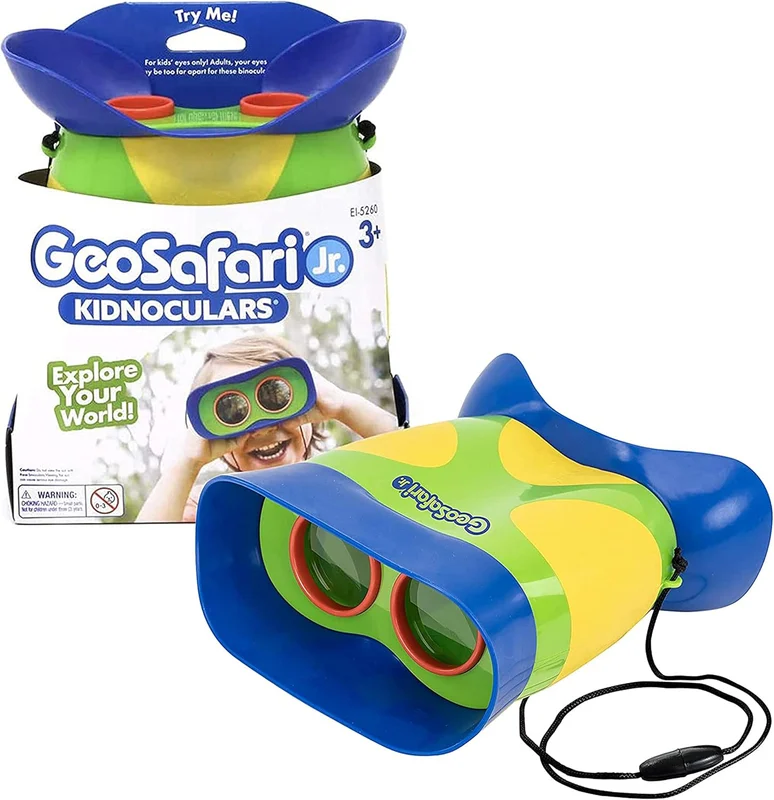
Educational Insights GeoSafari Kidnoculars
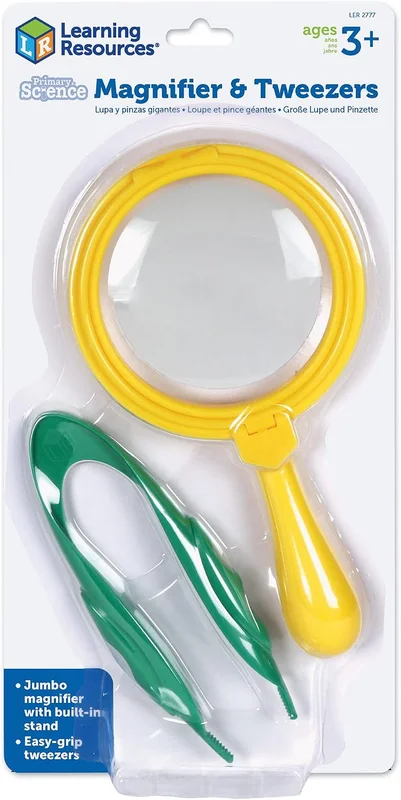
Learning Resources Primary Science Magnifier & Tweezers
Match each tool to a question
| Observation job | Product to consider | Supported details | Limit to plan around |
|---|---|---|---|
| “What is that in the tree?” | GeoSafari Kidnoculars | Focus-free 2x viewing, enlarged eyepieces, breakaway strap; model 5260, ages 3+ | Nearby scanning is the realistic job; the adult keeps the child still and away from wildlife |
| “What texture is on this leaf?” | Primary Science Magnifier & Tweezers | LER2777; 4.5x lens, built-in stand, 6-inch tweezers, no batteries, ages 3+ | Leave tweezers stored when the park requires look-only observation |
| “What tree activity can we repeat?” | Backpack Explorer: Discovering Trees | Ages 4+; 12 interactive field guides, 50 stickers, six games, three sensory hunts, real magnifier, pull-out journal | It centers on trees and takes more bag space than a notebook |
| “Can we explore several ways today?” | Toysmith Nature Explorer Set | Model 6021; seven tools, including viewing jars, magnifier, net, and handling tools; Toysmith lists ages 5+ | The tool count needs a carry plan and adult supervision |

Backpack Explorer: Discovering Trees
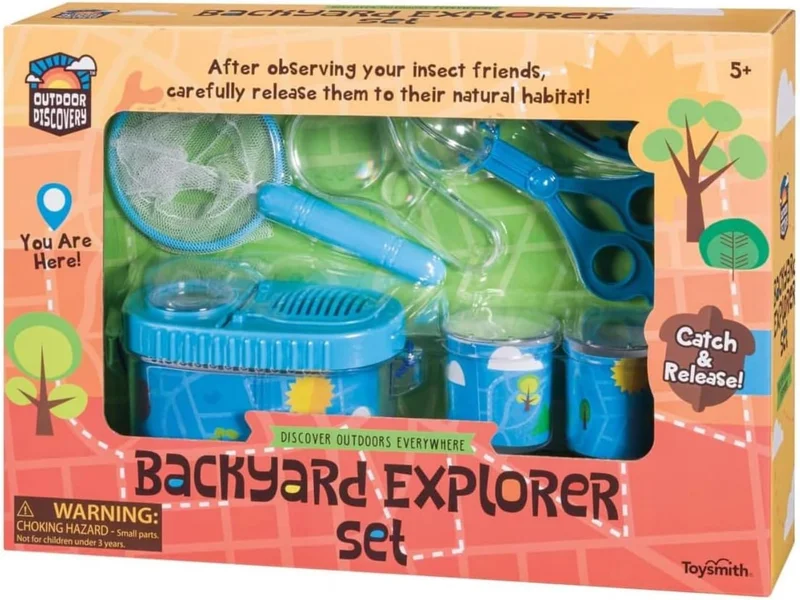
Toysmith Nature Explorer Set
Start with Kidnoculars when the child points at a bird, sign, or treetop and wants a closer view. They remove the focus step and keep the first experiment short. Start with the Learning Resources magnifier when the child sits beside a safe surface and asks about texture, edge, or pattern.
Choose Backpack Explorer when the activity needs a prompt as well as a tool. Its tree-centered pages pair observation with a pull-out record, so the child can return to the same tree. Choose Toysmith’s seven-tool set when the family has a clear plan for carrying and storing the pieces.
Keep the kit small
A notebook and pencil can test every job before a purchase. Add the tool that solves the question the child repeats. The best binoculars guide compares simple and adult-held optics. The best magnifying glass guide compares one close-look tool with a six-piece set.
Do not treat a long tool list as a better outing. A magnifier should not lead to picking. Binoculars should not lead to approaching a nest. A net or viewer should stay home when the park requires observation without capture.
Plan carrying and cleanup
Give one adult responsibility for lenses, containers, and small parts. Put the kit away before moving to playground equipment. Clean products according to their instructions and check that every piece returns to the bag. For ages 3–4, hand over one tool at a time.
For tree or leaf work, leave living plants in place. A child can draw the edge, count visible marks, or describe color without collecting. The nature activities without collecting guide supplies a no-gear alternative.
Decide what earns a place
Buy Kidnoculars when the child wants distant looks, the magnifier when the child wants stationary detail, Backpack Explorer when prompts sustain a tree route, or Toysmith when several tool types will be used repeatedly. Borrow first when the child’s question keeps changing.
Product details were checked against current Amazon listings and manufacturer pages on 2026-09-12; availability, age labels, and specifications can change. The products above were not field-tested by this site.